
- Fab Lab Kids
The Project Gutenberg eBook of The Dawn of a To
Time: 2010-12-5 17:23:32 Author: Organic Toys Source: Craft Kits Views: Comments:0Summary: E-text prepared by Charles Kellerwith OmniPage Professional OCR software donated by Caere Corporatio remote control trucks for 9 year oldsE-text prepared by Charles Keller
with OmniPage Professional OCR software donated by Caere Corporation
HTML version prepared by Juliet Sutherland,remote control trucks for 9 year olds Melissa Er-Raqabi,
and the Project Gutenberg Online Distributed Proofreading Team
https://www.pgdp.net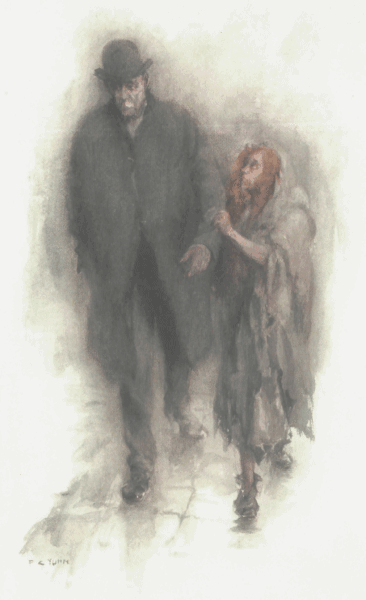
Something made him turn and go with her.
THE DAWN OF
A TO-MORROW
By
FRANCES HODGSONBURNETT
ILLUSTRATED
Charles Scribner's Sons
New York1906
ILLUSTRATIONS
From drawings in color by F. C. Yohn
Something made him turn and go with her (Frontispiece) Antony Dart examined it critically The girl held out her hand cautiously—the piece of gold lying upon its palm "God!" he cried. "Will I come?" "I'm alive! I'm alive!" she cried out "Speak, Lord, thy servant 'eareth" "There—is—no—death." "And a few hours ago you were on the point of—" THE DAWN OF A TO-MORROW
I
There are always two ways of looking at a thing, frequently there are sixor seven; but two ways of looking at a London fog are quite enough. Whenit is thick and yellow in the streets and stings a man's throat and lungsas he breathes it, an awakening in the early morning is either anunearthly and grewsome, or a mysteriously enclosing, secluding, andcomfortable thing. If one awakens in a healthy body, and with a clearbrain rested by normal sleep and retaining memories of a normallyagreeable yesterday, one may lie watching the housemaid building the fire;and after she has swept the hearth and put things in order, lie watchingthe flames of the blazing and crackling wood catch the coals and set themblazing also, and dancing merrily and filling corners with a glow; and inso lying and realizing that leaping light and warmth and a soft bed aregood things, one may turn over on one's back, stretching arms and legsluxuriously, drawing deep breaths and smiling at a knowledge of the fogoutside which makes half-past eight o'clock on a December morning as darkas twelve o'clock on a December night. Under such conditions the soft,thick, yellow gloom has its picturesque and even humorous aspect. Onefeels enclosed by it at once fantastically and cosily, and is inclined torevel in imaginings of the picture outside, its Rembrandt lights andorange yellows, the halos about the street-lamps, the illumination ofshop-windows, the flare of torches stuck up over coster barrows andcoffee-stands, the shadows on the faces of the men and women selling andbuying beside them. Refreshed by sleep and comfort and surrounded bylight, warmth, and good cheer, it is easy to face the day, to confrontgoing out into the fog and feeling a sort of pleasure in its mysteries.This is one way of looking at it, but only one.
The other way is marked by enormous differences.
A man—he had given his name to the people of the house as AntonyDart—awakened in a third-story bedroom in a lodging-house in a poorstreet in London, and as his consciousness returned to him, its slow andreluctant movings confronted the second point of view—marked by enormousdifferences. He had not slept two consecutive hours through the night, andwhen he had slept he had been tormented by dreary dreams, which were morefull of misery because of their elusive vagueness, which kept his torturedbrain on a wearying strain of effort to reach some definite understandingof them. Yet when he awakened the consciousness of being again alive wasan awful thing. If the dreams could have faded into blankness and allhave passed with the passing of the night, how he could have thankedwhatever gods there be! Only not to awake—only not to awake! But he hadawakened.
The clock struck nine as he did so, consequently he knew the hour. Thelodging-house slavey had aroused him by coming to light the fire. She hadset her candle on the hearth and done her work as stealthily as possible,but he had been disturbed, though he had made a desperate effort tostruggle back into sleep. That was no use—no use. He was awake and he wasin the midst of it all again. Without the sense of luxurious comfort heopened his eyes and turned upon his back, throwing out his arms flatly,so that he lay as in the form of a cross, in heavy weariness and anguish.For months he had awakened each morning after such a night and had so lainlike a crucified thing.
As he watched the painful flickering of the damp and smoking wood and coalhe remembered this and thought that there had been a lifetime of suchawakenings, not knowing that the morbidness of a fagged brain blotted outthe memory of more normal days and told him fantastic lies which were buta hundredth part truth. He could see only the hundredth part truth, and itassumed proportions so huge that he could see nothing else. In such astate the human brain is an infernal machine and its workings can only beconquered if the mortal thing which lives with it—day and night, nightand day—has learned to separate its controllable from its seeminglyuncontrollable atoms, and can silence its clamor on its way to madness.
Antony Dart had not learned this thing and the clamor had had its hideousway with him. Physicians would have given a name to his mental andphysical condition. He had heard these names often—applied to men thestrain of whose lives had been like the strain of his own, and had leftthem as it had left him—jaded, joyless, breaking things. Some of them hadbeen broken and had died or were dragging out bruised and tormented daysin their own homes or in mad-houses. He always shuddered when he heardtheir names, and rebelled with sick fear against the mere mention ofthem. They had worked as he had worked, they had been stricken with thedelirium of accumulation—accumulation—as he had been. They had beencaught in the rush and swirl of the great maelstrom, and had been borneround and round in it, until having grasped every coveted thing tossingupon its circling waters, they themselves had been flung upon the shorewith both hands full, the rocks about them strewn with rich possessions,while they lay prostrate and gazed at all life had brought with dull,hopeless, anguished eyes. He knew—if the worst came to the worst—whatwould be said of him, because he had heard it said of others. "He workedtoo hard—he worked too hard." He was sick of hearing it. What was wrongwith the world—what was wrong with man, as Man—if work could break himlike this? If one believed in Deity, the living creature It breathed intobeing must be a perfect thing—not one to be wearied, sickened, torturedby the life Its breathing had created. A mere man would disdain to build athing so poor and incomplete. A mere human engineer who constructed anengine whose workings were perpetually at fault—which went wrong whencalled upon to do the labor it was made for—who would not scoff at it andcast it aside as a piece of worthless bungling?
"Something is wrong," he muttered, lying flat upon his cross and staringat the yellow haze which had crept through crannies in window-sashes intothe room. "Someone is wrong. Is it I—or You?"
His thin lips drew themselves back against his teeth in a mirthless smilewhich was like a grin.
"Yes," he said. "I am pretty far gone. I am beginning to talk to myselfabout God. Bryan did it just before he was taken to Dr. Hewletts' placeand cut his throat."
He had not led a specially evil life; he had not broken laws, but thesubject of Deity was not one which his scheme of existence had included.When it had haunted him of late he had felt it an untoward and morbidsign. The thing had drawn him—drawn him; he had complained against it,he had argued, sometimes he knew—shuddering—that he had raved. Somethinghad seemed to stand aside and watch his being and his thinking. Somethingwhich filled the universe had seemed to wait, and to have waited throughall the eternal ages, to see what he—one man—would do. At times a greatappalled wonder had swept over him at his realization that he had neverknown or thought of it before. It had been there always—through all theages that had passed. And sometimes—once or twice—the thought had insome unspeakable, untranslatable way brought him a moment's calm.
But at other times he had said to himself—with a shivering soul coweringwithin him—that this was only part of it all and was a beginning,perhaps, of religious monomania.
During the last week he had known what he was going to do—he had made uphis mind. This abject horror through which others had let themselves bedragged to madness or death he would not endure. The end should comequickly, and no one should be smitten aghast by seeing or knowing how itcame. In the crowded shabbier streets of London there were lodging-houseswhere one, by taking precautions, could end his life in such a manner aswould blot him out of any world where such a man as himself had beenknown. A pistol, properly managed, would obliterate resemblance to anyhuman thing. Months ago through chance talk he had heard how it could bedone—and done quickly. He could leave a misleading letter. He had plannedwhat it should be—the story it should tell of a disheartened mediocreventurer of his poor all returning bankrupt and humiliated from Australia,ending existence in such pennilessness that the parish must give him apauper's grave. What did it matter where a man lay, so that heslept—slept—slept? Surely with one's brains scattered one would sleepsoundly anywhere.
He had come to the house the night before, dressed shabbily with thepitiable respectability of a defeated man. He had entered droopingly withbent shoulders and hopeless hang of head. In his own sphere he was a manwho held himself well. He had let fall a few dispirited sentences when hehad engaged his back room from the woman of the house, and she hadrecognized him as one of the luckless. In fact, she had hesitated a momentbefore his unreliable look until he had taken out money from his pocketand paid his rent for a week in advance. She would have that at least forher trouble, he had said to himself. He should not occupy the room afterto-morrow. In his own home some days would pass before his household beganto make inquiries. He had told his servants that he was going over toParis for a change. He would be safe and deep in his pauper's grave a weekbefore they asked each other why they did not hear from him. All was inorder. One of the mocking agonies was that living was done for. He hadceased to live. Work, pleasure, sun, moon, and stars had lost theirmeaning. He stood and looked at the most radiant loveliness of land andsky and sea and felt nothing. Success brought greater wealth each daywithout stirring a pulse of pleasure, even in triumph. There was nothingleft but the awful days and awful nights to which he knew physicians couldgive their scientific name, but had no healing for. He had gone farenough. He would go no farther. To-morrow it would have been over longhours. And there would have been no public declaiming over the humiliatingpitifulness of his end. And what did it matter?
How thick the fog was outside—thick enough for a man to lose himself init. The yellow mist which had crept in under the doors and through thecrevices of the window-sashes gave a ghostly look to the room—a ghastly,abnormal look, he said to himself. The fire was smouldering instead ofblazing. But what did it matter? He was going out. He had not bought thepistol last night—like a fool. Somehow his brain had been so tired andcrowded that he had forgotten.
"Forgotten." He mentally repeated the word as he got out of bed. By thistime to-morrow he should have forgotten everything. This time to-morrow.His mind repeated that also, as he began to dress himself. Where should hebe? Should he be anywhere? Suppose he awakened again—to something as badas this? How did a man get out of his body? After the crash and shock whathappened? Did one find oneself standing beside the Thing and looking downat it? It would not be a good thing to stand and look down on—even forthat which had deserted it. But having torn oneself loose from it and itsdevilish aches and pains, one would not care—one would see how little itall mattered. Anything else must be better than this—the thing for whichthere was a scientific name but no healing. He had taken all the drugs, hehad obeyed all the medical orders, and here he was after that last hell ofa night—dressing himself in a back bedroom of a cheap lodging-house to goout and buy a pistol in this damned fog.
He laughed at the last phrase of his thought, the laugh which was amirthless grin.
"I am thinking of it as if I was afraid of taking cold," he said. "Andto-morrow—!"
There would be no To-morrow. To-morrows were at an end. No more nights—nomore days—no more morrows.
He finished dressing, putting on his discriminatingly chosenshabby-genteel clothes with a care for the effect he intended them toproduce. The collar and cuffs of his shirt were frayed and yellow, and hefastened his collar with a pin and tied his worn necktie carelessly. Hisovercoat was beginning to wear a greenish shade and look threadbare, sowas his hat. When his toilet was complete he looked at himself in thecracked and hazy glass, bending forward to scrutinize his unshaven faceunder the shadow of the dingy hat.
"It is all right," he muttered. "It is not far to the pawnshop where I sawit."
The stillness of the room as he turned to go out was uncanny. As it was aback room, there was no street below from which could arise sounds ofpassing vehicles, and the thickness of the fog muffled such sound as mighthave floated from the front. He stopped half-way to the door, not knowingwhy, and listened. To what—for what? The silence seemed to spread throughall the house—out into the streets—through all London—through all theworld, and he to stand in the midst of it, a man on the way to Death—withno To-morrow.
What did it mean? It seemed to mean something. The world withdrawn—lifewithdrawn—sound withdrawn—breath withdrawn. He stood and waited. Perhapsthis was one of the symptoms of the morbid thing for which there was thatname. If so he had better get away quickly and have it over, lest he befound wandering about not knowing—not knowing. But now he knew—theSilence. He waited—waited and tried to hear, as if something was callinghim—calling without sound. It returned to him—the thought of That whichhad waited through all the ages to see what he—one man—would do. He hadnever exactly pitied himself before—he did not know that he pitiedhimself now, but he was a man going to his death, and a light, cold sweatbroke out on him and it seemed as if it was not he who did it, but someother—he flung out his arms and cried aloud words he had not known hewas going to speak.
"Lord! Lord! What shall I do to be saved?"
But the Silence gave no answer. It was the Silence still.
And after standing a few moments panting, his arms fell and his headdropped, and turning the handle of the door, he went out to buy thepistol.
II
As he went down the narrow staircase, covered with its dingy andthreadbare carpet, he found the house so full of dirty yellow haze that herealized that the fog must be of the extraordinary ones which areremembered in after-years as abnormal specimens of their kind. He recalledthat there had been one of the sort three years before, and that trafficand business had been almost entirely stopped by it, that accidents hadhappened in the streets, and that people having lost their way hadwandered about turning corners until they found themselves far from theirintended destinations and obliged to take refuge in hotels or the housesof hospitable strangers. Curious incidents had occurred and odd storieswere told by those who had felt themselves obliged by circumstances to goout into the baffling gloom. He guessed that something of a like naturehad fallen upon the town again. The gas-light on the landings and in themelancholy hall burned feebly—so feebly that one got but a vague view ofthe rickety hat-stand and the shabby overcoats and head-gear hanging uponit. It was well for him that he had but a corner or so to turn before hereached the pawnshop in whose window he had seen the pistol he intended tobuy.
When he opened the street-door he saw that the fog was, upon the whole,perhaps even heavier and more obscuring, if possible, than the one so wellremembered. He could not see anything three feet before him, he could notsee with distinctness anything two feet ahead. The sensation of steppingforward was uncertain and mysterious enough to be almost appalling. A mannot sufficiently cautious might have fallen into any open hole in hispath. Antony Dart kept as closely as possible to the sides of the houses.It would have been easy to walk off the pavement into the middle of thestreet but for the edges of the curb and the step downward from its level.Traffic had almost absolutely ceased, though in the more important streetslink-boys were making efforts to guide men or four-wheelers slowly along.The blind feeling of the thing was rather awful. Though but fewpedestrians were out, Dart found himself once or twice brushing against orcoming into forcible contact with men feeling their way about likehimself.
"One turn to the right," he repeated mentally, "two to the left, and theplace is at the corner of the other side of the street"
He managed to reach it at last, but it had been a slow, and therefore,long journey. All the gas-jets the little shop owned were lighted, buteven under their flare the articles in the window—the one or two oncecheaply gaudy dresses and shawls and men's garments—hung in the hazelike the dreary, dangling ghosts of things recently executed. Amongwatches and forlorn pieces of old-fashioned jewelry and odds and ends, thepistol lay against the folds of a dirty gauze shawl. There it was. Itwould have been annoying if someone else had been beforehand and hadbought it.
Inside the shop more dangling spectres hung and the place was almost dark.It was a shabby pawnshop, and the man lounging behind the counter was ashabby man with an unshaven, unamiable face.
"I want to look at that pistol in the right-hand corner of your window,"Antony Dart said.
The pawnbroker uttered a sound something between a half-laugh and agrunt. He took the weapon from the window.
Antony Dart examined it critically. He must make quite sure of it. He madeno further remark. He felt he had done with speech.
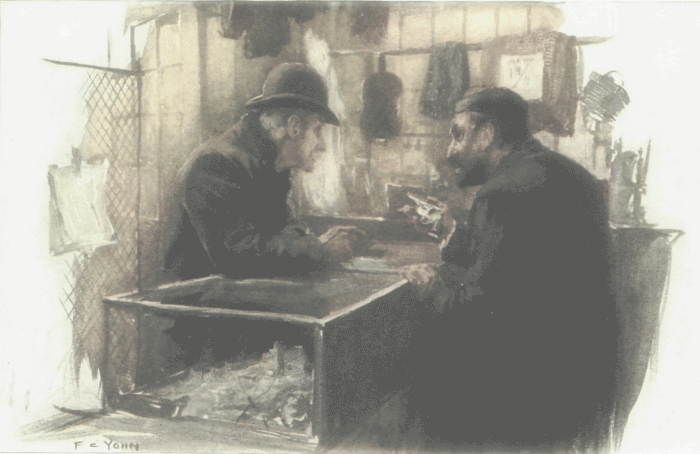
Antony Dart examined it critically
Being told the price asked for the purchase, he drew out his purse andtook the money from it. After making the payment he noted that he stillpossessed a five-pound note and some sovereigns. There passed through hismind a wonder as to who would spend it. The most decent thing, perhaps,would be to give it away. If it was in his room—to-morrow—the parishwould not bury him, and it would be safer that the parish should.
He was thinking of this as he left the shop and began to cross thestreet. Because his mind was wandering he was less watchful. Suddenly arubber-tired hansom, moving without sound, appeared immediately in hispath—the horse's head loomed up above his own. He made the inevitableinvoluntary whirl aside to move out of the way, the hansom passed, andturning again, he went on. His movement had been too swift to allow of hisrealizing the direction in which his turn had been made. He was whollyunaware that when he crossed the street he crossed backward instead offorward. He turned a corner literally feeling his way, went on, turnedanother, and after walking the length of the street, suddenly understoodthat he was in a strange place and had lost his bearings.
This was exactly what had happened to people on the day of the memorablefog of three years before. He had heard them talking of such experiences,and of the curious and baffling sensations they gave rise to in the brain.Now he understood them. He could not be far from his lodgings, but he feltlike a man who was blind, and who had been turned out of the path he knew.He had not the resource of the people whose stories he had heard. He wouldnot stop and address anyone. There could be no certainty as to whom hemight find himself speaking to. He would speak to no one. He would wanderabout until he came upon some clew. Even if he came upon none, the fogwould surely lift a little and become a trifle less dense in course oftime. He drew up the collar of his overcoat, pulled his hat down over hiseyes and went on—his hand on the thing he had thrust into a pocket.
He did not find his clew as he had hoped, and instead of lifting the foggrew heavier. He found himself at last no longer striving for any end, butrambling along mechanically, feeling like a man in a dream—a nightmare.Once he recognized a weird suggestion in the mystery about him. To-morrowmight one be wandering about aimlessly in some such haze. He hoped not.
His lodgings were not far from the Embankment, and he knew at last thathe was wandering along it, and had reached one of the bridges. His moodled him to turn in upon it, and when he reached an embrasure to stop nearit and lean upon the parapet looking down. He could not see the water, thefog was too dense, but he could hear some faint splashing against stones.He had taken no food and was rather faint. What a strange thing it was tofeel faint for want of food—to stand alone, cut off from every otherhuman being—everything done for. No wonder that sometimes, particularlyon such days as these, there were plunges made from the parapet—nowonder. He leaned farther over and strained his eyes to see some gleam ofwater through the yellowness. But it was not to be done. He was thinkingthe inevitable thing, of course; but such a plunge would not do for him.The other thing would destroy all traces.
As he drew back he heard something fall with the solid tinkling sound ofcoin on the flag pavement. When he had been in the pawn-broker's shop hehad taken the gold from his purse and thrust it carelessly into hiswaistcoat pocket, thinking that it would be easy to reach when he chose togive it to one beggar or another, if he should see some wretch who wouldbe the better for it. Some movement he had made in bending had caused asovereign to slip out and it had fallen upon the stones.
He did not intend to pick it up, but in the moment in which he stoodlooking down at it he heard close to him a shuffling movement. What he hadthought a bundle of rags or rubbish covered with sacking—some tramp'sdeserted or forgotten belongings—was stirring. It was alive, and as hebent to look at it the sacking divided itself, and a small head, coveredwith a shock of brilliant red hair, thrust itself out, a shrewd, smallface turning to look up at him slyly with deep-set black eyes.
It was a human girl creature about twelve years old.
"Are yer goin' to do it?" she said in a hoarse, street-strained voice."Yer would be a fool if yer did—with as much as that on yer."
She pointed with a reddened, chapped, and dirty hand at the sovereign.
"Pick it up," he said. "You may have it."
Her wild shuffle forward was an actual leap. The hand made a snatchingclutch at the coin. She was evidently afraid that he was either not inearnest or would repent. The next second she was on her feet and ready forflight.
"Stop," he said; "I've got more to give away."
She hesitated—not believing him, yet feeling it madness to lose a chance.
"More!"she gasped. Then she drew nearer to him, and a singular changecame upon her face. It was a change which made her look oddly human.
"Gawd, mister!" she said. "Yer can give away a quid like it wasnothin'—an' yer've got more—an' yer goin' to do that—jes cos yer 'ada bit too much lars night an' there's a fog this mornin'! You take itstraight from me—don't yer do it. I give yer that tip for the suvrink."
She was, for her years, so ugly and so ancient, and hardened in voice andskin and manner that she fascinated him. Not that a man who has noTo-morrow in view is likely to be particularly conscious of mentalprocesses. He was done for, but he stood and stared at her. What part ofthe Power moving the scheme of the universe stood near and thrust him onin the path designed he did not know then—perhaps never did. He was stillholding on to the thing in his pocket, but he spoke to her again.
"What do you mean?" he asked glumly.
She sidled nearer, her sharp eyes on his face.
"I bin watchin' yer," she said. "I sat down and pulled the sack over me'ead to breathe inside it an' get a bit warm. An' I see yer come. I knowedwot yer was after, I did. I watched yer through a 'ole in me sack. Iwasn't goin' to call a copper. I shouldn't want ter be stopped meself if Imade up me mind. I seed a gal dragged out las' week an' it'd a broke yer'art to see 'er tear 'er clothes an' scream. Wot business 'ad theypreventin' 'er goin' off quiet? I wouldn't 'a' stopped yer—but w'en thequid fell, that made it different."
"I—" he said, feeling the foolishness of the statement, but making it,nevertheless, "I am ill."
"Course yer ill. It's yer 'ead. Come along er me an' get a cup er cawfeeat a stand, an' buck up. If yer've give me that quidstraight—wish-yer-may-die—I'll go with yer an' get a cup myself. I ain't'ad a bite since yesterday—an' 't wa'n't nothin' but a slice o' polonysossidge I found on a dust-'eap. Come on, mister."
She pulled his coat with her cracked hand. He glanced down at itmechanically, and saw that some of the fissures had bled and the roughenedsurface was smeared with the blood. They stood together in the small spacein which the fog enclosed them—he and she—the man with no To-morrow andthe girl thing who seemed as old as himself, with her sharp, small noseand chin, her sharp eyes and voice—and yet—perhaps the fogs enclosingdid it—something drew them together in an uncanny way. Something made himforget the lost clew to the lodging-house—something made him turn and gowith her—a thing led in the dark.
"How can you find your way?" he said. "I lost mine."
"There ain't no fog can lose me," she answered, shuffling along by hisside; "'sides, it's goin' to lift. Look at that man comin' to'ards us."
It was true that they could see through the orange-colored mist theapproaching figure of a man who was at a yard's distance from them. Yes,it was lifting slightly—at least enough to allow of one's making a guessat the direction in which one moved.
"Where are you going?" he asked.
"Apple Blossom Court," she answered. "The cawfee-stand's in a street nearit—and there's a shop where I can buy things."
"Apple Blossom Court!" he ejaculated. "What a name!"
"There ain't no apple-blossoms there," chuckling; "nor no smell of 'em.'T ain't as nice as its nime is—Apple Blossom Court ain't."
"What do you want to buy? A pair of shoes?" The shoes her naked feet werethrust into were leprous-looking things through which nearly all her toesprotruded. But she chuckled when he spoke.
"No, I'm goin' to buy a di'mond tirarer to go to the opery in," she said,dragging her old sack closer round her neck. "I ain't ad a noo un since Iwent to the last Drorin'-room."
It was impudent street chaff, but there was cheerful spirit in it, andcheerful spirit has some occult effect upon morbidity. Antony Dart didnot smile, but he felt a faint stirring of curiosity, which was, afterall, not a bad thing for a man who had not felt an interest for a year.
"What is it you are going to buy?"
"I'm goin' to fill me stummick fust," with a grin of elation. "Three thickslices o' bread an' drippin' an' a mug o' cawfee. An' then I'm goin' toget sumethin' 'earty to carry to Polly. She ain't no good, pore thing!"
"Who is she?"
Stopping a moment to drag up the heel of her dreadful shoe, she answeredhim with an unprejudiced directness which might have been appalling if hehad been in the mood to be appalled.
"Ain't eighteen, an' tryin' to earn 'er livin' on the street. She ain'tmade for it. Little country thing, allus frightened to death an' ready tobust out cryin'. Gents ain't goin' to stand that. A lot of 'em wantscheerin' up as much as she does. Gent as was in liquor last night knocked'er down an' give 'er a black eye. 'Twan't ill feelin', but he lost histemper, an' give 'er a knock casual. She can't go out to-night, an' she'sbeen 'uddled up all day cry in' for 'er mother."
"Where is her mother?"
"In the country—on a farm. Polly took a place in a lodgin'-'ouse an' gotin trouble. The biby was dead, an' when she come out o' Queen Charlotte'sshe was took in by a woman an' kep'. She kicked 'er out in a week 'cos ofher cryin'. The life didn't suit 'er. I found 'er cryin' fit to split 'erchist one night—corner o' Apple Blossom Court—an' I took care of 'er."
"Where?"
"Me chambers," grinning; "top loft of a 'ouse in the court. If anyone else'd 'ave it I should be turned out. It's an 'ole, I can tell yer—but it'sbetter than sleepin' under the bridges."
"Take me to see it," said Antony Dart, "I want to see the girl."
The words spoke themselves. Why should he care to see either cockloft orgirl? He did not. He wanted to go back to his lodgings with that which hehad come out to buy. Yet he said this thing. His companion looked up athim with an expression actually relieved.
"Would yer tike up with 'er?" with eager sharpness, as if confronting asimple business proposition. "She's pretty an' clean, an' she won't drinka drop o' nothin'. If she was treated kind she'd be cheerfler. She's got around fice an' light 'air an' eyes. 'Er 'air's curly. P'raps yer'd like'er."
"Take me to see her."
"She'd look better to-morrow," cautiously, "when the swellin's gone downround 'er eye."
Dart started—and it was because he had for the last five minutesforgotten something.
"I shall not be here to-morrow," he said. His grasp upon the thing in hispocket had loosened, and he tightened it.
"I have some more money in my purse," he said deliberately. "I meant togive it away before going. I want to give it to people who need it verymuch."
She gave him one of the sly, squinting glances.
"Deservin' cases?" She put it to him in brazen mockery.
"I don't care," he answered slowly and heavily. "I don't care a damn."
Her face changed exactly as he had seen it change on the bridge when shehad drawn nearer to him. Its ugly hardness suddenly looked human. And thatshe could look human was fantastic.
"'Ow much 'ave yer?" she asked. "'Ow much is it?"
"About ten pounds."
She stopped and stared at him with open mouth.
"Gawd!" she broke out; "ten pounds 'd send Apple Blossom Court to 'eving.Leastways, it'd take some of it out o' 'ell."
"Take me to it," he said roughly. "Take me."
She began to walk quickly, breathing fast. The fog was lighter, and it wasno longer a blinding thing.
A question occurred to Dart.
"Why don't you ask me to give the money to you?" he said bluntly.
"Dunno," she answered as bluntly. But after taking a few steps farther shespoke again.
"I'm cheerfler than most of 'em," she elaborated. "If yer born cheerfleyer can stand things. When I gets a job nussin' women's bibles they don'tcry when I 'andles 'em. I gets many a bite an' a copper 'cos o' that.Folks likes yer. I shall get on better than Polly when I'm old enough togo on the street."
The organ of whose lagging, sick pumpings Antony Dart had scarcely beenaware for months gave a sudden leap in his breast. His blood actuallyhastened its pace, and ran through his veins instead of crawling—adistinct physical effect of an actual mental condition. It was producedupon him by the mere matter-of-fact ordinariness of her tone. He had neverbeen a sentimental man, and had long ceased to be a feeling one, but atthat moment something emotional and normal happened to him.
"You expect to live in that way?" he said.
"Ain't nothin' else fer me to do. Wisht I was better lookin'. But I've gota lot of 'air," clawing her mop, "an' it's red. One day," chuckling, "agent ses to me—he ses: 'Oh! yer'll do. Yer an ugly little devil—but yearea devil.'"
She was leading him through a narrow, filthy back street, and she stopped,grinning up in his face.
"I say, mister," she wheedled, "let's stop at the cawfee-stand. It's upthis way."
When he acceded and followed her, she quickly turned a corner. They werein another lane thick with fog, which flared with the flame of torchesstuck in costers' barrows which stood here and there—barrows with friedfish upon them, barrows with second-hand-looking vegetables and otherspiled with more than second-hand-looking garments. Trade was not driving,but near one or two of them dirty, ill-used looking women, a man or so,and a few children stood. At a corner which led into a black hole of acourt, a coffee-stand was stationed, in charge of a burly ruffian incorduroys.
"Come along," said the girl. "There it is. It ain't strong, but it's 'ot."
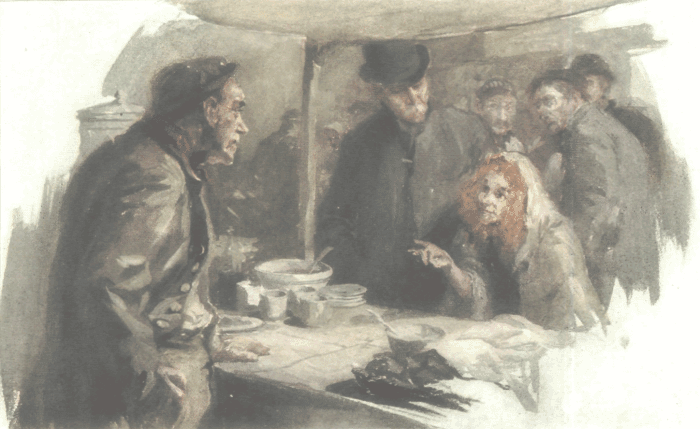
The girl held out her hand cautiously—the piece of gold lying upon its palm.
She sidled up to the stand, drawing Dart with her, as if glad of hisprotection.
"'Ello, Barney," she said. "'Ere's a gent warnts a mug o' yer best. I've'ad a bit o' luck, an' I wants one meself."
"Garn," growled Barney. "You an' yer luck! Gent may want a mug, but y'dshow yer money fust."
"Strewth! I've got it. Y' ain't got the chinge fer wot I 'ave in me 'and'ere. 'As 'e, mister?"'
"Show it," taunted the man, and then turning to Dart. "Yer wants a mug o'cawfee?"
"Yes."
The girl held out her hand cautiously—the piece of gold lying upon itspalm.
"Look 'ere," she said.
There were two or three men slouching about the stand. Suddenly a handdarted from between two of them who stood nearest, the sovereign wassnatched, a screamed oath from the girl rent the thick air, and a forlornenough scarecrow of a young fellow sprang away.
The blood leaped in Antony Dart's veins again and he sprang after him in awholly normal passion of indignation. A thousand years ago—as it seemedto him—he had been a good runner. This man was not one, and want of foodhad weakened him. Dart went after him with strides which astonishedhimself. Up the street, into an alley and out of it, a dozen yards moreand into a court, and the man wheeled with a hoarse, baffled curse. Theplace had no outlet.
"Hell!" was all the creature said.
Dart took him by his greasy collar. Even the brief rush had left himfeeling like a living thing—which was a new sensation.
"Give it up," he ordered.
The thief looked at him with a half-laugh and obeyed, as if he felt theuselessness of a struggle. He was not more than twenty-five years old, andhis eyes were cavernous with want. He had the face of a man who might havebelonged to a better class. When he had uttered the exclamation invokingthe infernal regions he had not dropped the aspirate.
"I'm as hungry as she is," he raved.
"Hungry enough to rob a child beggar?" said Dart.
"Hungry enough to rob a starving old woman—or a baby," with a defiantsnort. "Wolf hungry—tiger hungry—hungry enough to cut throats."
He whirled himself loose and leaned his body against the wall, turning hisface toward it. Suddenly he made a choking sound and began to sob.
"Hell!" he choked. "I'll give it up! I'll give it up!"
What a figure—what a figure, as he swung against the blackened wall, hisscarecrow clothes hanging on him, their once decent material making theirpinning together of buttonless places, their looseness and rents showingdirty linen, more abject than any other squalor could have made them.Antony Dart's blood, still running warm and well, was doing its normalwork among the brain-cells which had stirred so evilly through the night.When he had seized the fellow by the collar, his hand had left his pocket.He thrust it into another pocket and drew out some silver.
"Go and get yourself some food," he said. "As much as you can eat. Then goand wait for me at the place they call Apple Blossom Court. I don't knowwhere it is, but I am going there. I want to hear how you came to this.Will you come?"
The thief lurched away from the wall and toward him. He stared up intohis eyes through the fog. The tears had smeared his cheekbones.
"God!" he said. "Will I come? Look and see if I'll come," Dart looked.
"Yes, you'll come," he answered, and he gave him the money. "I'm goingback to the coffee-stand."
The thief stood staring after him as he went out of the court. Dart wasspeaking to himself.
"I don't know why I did it," he said. "But the thing had to be done."
In the street he turned into he came upon the robbed girl, running,panting, and crying. She uttered a shout and flung herself upon him,clutching his coat.
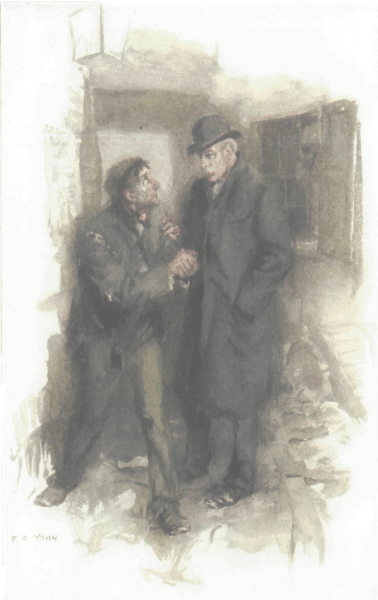
"God!" he cried. "Will I come?"
"Gawd!" she sobbed hysterically, "I thort I'd lost yer! I thort I'd lostall of it, I did! Strewth! I'm glad I've found yer—" and she stopped,choking with her sobs and sniffs, rubbing her face in her sack.
"Here is your sovereign," Dart said, handing it to her.
She dropped the corner of the sack and looked up with a queer laugh.
"Did yer find a copper? Did yer give him in charge?"
"No," answered Dart. "He was worse off than you. He was starving. I tookthis from him; but I gave him some money and told him to meet us at AppleBlossom Court."
She stopped short and drew back a pace to stare up at him.
"Well," she gave forth, "y' area queer one!"
And yet in the amazement on her face he perceived a remote dawning of anunderstanding of the meaning of the thing he had done.
He had spoken like a man in a dream. He felt like a man in a dream, beingled in the thick mist from place to place. He was led back to thecoffee-stand, where now Barney, the proprietor, was pouring out coffee fora hoarse-voiced coster girl with a draggled feather in her hat, whogreeted their arrival hilariously.
"Hello, Glad!" she cried out "Got yer suvrink back?"
Glad—it seemed to be the creature's wild name—nodded, but held close toher companion's side, clutching his coat.
"Let's go in there an' change it," she said, nodding toward a small porkand ham shop near by. "An' then yer can take care of it for me."
"What did she call you?" Antony Dart asked her as they went.
"Glad. Don't know as I ever 'ad a nime o' me own, but a little cove aswent once to the pantermine told me about a young lady as was Fairy Queenan' 'er name was Gladys Beverly St. John, so I called meself that. No onenever said it all at onct—they don't never say nothin' but Glad. I'm gladenough this mornin'," chuckling again, "'avin' the luck to come up withyou, mister. Never had luck like it 'afore."
They went into the pork and ham shop and changed the sovereign. There wascooked food in the windows—roast pork and boiled ham and corned beef. Shebought slices of pork and beef, and of suet-pudding with a few currantssprinkled through it.
"Will yer 'elp me to carry it?" she inquired. "I'll 'ave to get a fewpen'worth o' coal an' wood an' a screw o' tea an' sugar. My wig, wot afeed me an' Polly'll 'ave!"
As they returned to the coffee-stand she broke more than once into a hopof glee. Barney had changed his mind concerning her. A solid sovereignwhich must be changed and a companion whose shabby gentility was absolutegrandeur when compared with his present surroundings made a difference.
She received her mug of coffee and thick slice of bread and dripping witha grin, and swallowed the hot sweet liquid down in ecstatic gulps.
"Ain't I in luck?" she said, handing her mug back when it was empty. "Gi'me another, Barney."
Antony Dart drank coffee also and ate bread and dripping. The coffee washot and the bread and dripping, dashed with salt, quite eatable. He hadneeded food and felt the better for it.
"Come on, mister," said Glad, when their meal was ended. "I want to getback to Polly, an' there's coal and bread and things to buy."
She hurried him along, breaking her pace with hops at intervals. Shedarted into dirty shops and brought out things screwed up in paper. Shewent last into a cellar and returned carrying a small sack of coal overher shoulders.
"Bought sack an' all," she said elatedly. "A sack's a good thing to 'ave."
"Let me carry it for you," said Antony Dart.
"Spile yer coat," with her sidelong upward glance.
"I don't care," he answered. "I don't care a damn."
The final expletive was totally unnecessary, but it meant a thing he didnot say. Whatsoever was thrusting him this way and that, speaking throughhis speech, leading him to do things he had not dreamed of doing, shouldhave its will with him. He had been fastened to the skirts of this beggarimp and he would go on to the end and do what was to be done this day. Itwas part of the dream.
The sack of coal was over his shoulder when they turned into Apple BlossomCourt. It would have been a black hole on a sunny day, and now it was likeHades, lit grimly by a gas-jet or two, small and flickering, with theorange haze about them. Filthy flagging, murky doorways, broken steps andbroken windows stuffed with rags, and the smell of the sewers let loosehad Apple Blossom Court.
Glad, with the wealth of the pork and ham shop and other riches in herarms, entered a repellent doorway in a spirit of great good cheer and Dartfollowed her. Past a room where a drunken woman lay sleeping with her headon a table, a child pulling at her dress and crying, up a stairway withbroken balusters and breaking steps, through a landing, upstairs again,and up still farther until they reached the top. Glad stopped before adoor and shook the handle, crying out:
"'S only me, Polly. You can open it." She added to Dart in an undertone:"She 'as to keep it locked. No knowin' who'd want to get in. Polly,"shaking the door-handle again, "Polly 's only me."
The door opened slowly. On the other side of it stood a girl with adimpled round face which was quite pale; under one of her childishlyvacant blue eyes was a discoloration, and her curly fair hair was tuckedup on the top of her head in a knot. As she took in the fact of AntonyDart's presence her chin began to quiver.
"I ain't fit to—to see no one," she stammered pitifully. "Why did you,Glad—why did you?"
"Ain't no 'arm in 'im," said Glad. "'E's one o' the friendly ones. 'Egive me a suvrink. Look wot I've got," hopping about as she showed herparcels.
"You need not be afraid of me," Antony Dart said. He paused a second,staring at her, and suddenly added, "Poor little wretch!"
Her look was so scared and uncertain a thing that he walked away from herand threw the sack of coal on the hearth. A small grate with broken barshung loosely in the fireplace, a battered tin kettle tilted drunkenly nearit. A mattress, from the holes in whose ticking straw bulged, lay on thefloor in a corner, with some old sacks thrown over it. Glad had, withoutdoubt, borrowed her shoulder covering from the collection. The garret wasas cold as the grave, and almost as dark; the fog hung in it thickly.There were crevices enough through which it could penetrate.
Antony Dart knelt down on the hearth and drew matches from his pocket.
"We ought to have brought some paper," he said.
Glad ran forward.
"Wot a gent ye are!" she cried. "Y' ain't never goin' to light it?"
"Yes."
She ran back to the rickety table and collected the scraps of paper whichhad held her purchases. They were small, but useful.
"That wot was round the sausage an' the puddin's greasy," she exulted.
Polly hung over the table and trembled at the sight of meat and bread.Plainly, she did not understand what was happening. The greased paper setlight to the wood, and the wood to the coal. All three flared and blazedwith a sound of cheerful crackling. The blaze threw out its glow asfinely as if it had been set alight to warm a better place. The wonder ofa fire is like the wonder of a soul. This one changed the murk and gloomto brightness, and the deadly damp and cold to warmth. It drew the girlPolly from the table despite her fears. She turned involuntarily, made twosteps toward it, and stood gazing while its light played on her face. Gladwhirled and ran to the hearth.
"Ye've put on a lot," she cried; "but, oh, my Gawd, don't it warm yer!Come on, Polly—come on."
She dragged out a wooden stool, an empty soap-box, and bundled the sacksinto a heap to be sat upon. She swept the things from the table and setthem in their paper wrappings on the floor.
"Let's all sit down close to it—close," she said, "an' get warm an' eat,an' eat."
She was the leaven which leavened the lump of their humanity. What thisleaven is—who has found out? But she—little rat of the gutter—wasformed of it, and her mere pure animal joy in the temporary animal comfortof the moment stirred and uplifted them from their depths.
III
They drew near and sat upon the substitutes for seats in a circle—and thefire threw up flame and made a glow in the fog hanging in the black holeof a room.
It was Glad who set the battered kettle on and when it boiled made tea.The other two watched her, being under her spell. She handed out slices ofbread and sausage and pudding on bits of paper. Polly fed with tremuloushaste; Glad herself with rejoicing and exulting in flavors. Antony Dartate bread and meat as he had eaten the bread and dripping at thestall—accepting his normal hunger as part of the dream.
Suddenly Glad paused in the midst of a huge bite.
"Mister," she said, "p'raps that cove's waitin' fer yer. Let's 'ave 'imin. I'll go and fetch 'im."
She was getting up, but Dart was on his feet first.
"I must go," he said. "He is expecting me and—"
"Aw," said Glad, "lemme go along o' yer, mister—jest to show there's noill feelin'."
"Very well," he answered.
It was she who led, and he who followed. At the door she stopped andlooked round with a grin.
"Keep up the fire, Polly," she threw back. "Ain't it warm and cheerful?It'll do the cove good to see it."
She led the way down the black, unsafe stairway. She always led.
Outside the fog had thickened again, but she went through it as if shecould see her way.
At the entrance to the court the thief was standing, leaning against thewall with fevered, unhopeful waiting in his eyes. He moved miserably whenhe saw the girl, and she called out to reassure him.
"I ain't up to no 'arm," she said; "I on'y come with the gent."
Antony Dart spoke to him.
"Did you get food?"
The man shook his head.
"I turned faint after you left me, and when I came to I was afraid I mightmiss you," he answered. "I daren't lose my chance. I bought some breadand stuffed it in my pocket. I've been eating it while I've stood here."
"Come back with us," said Dart. "We are in a place where we have somefood."
He spoke mechanically, and was aware that he did so. He was a pawn pushedabout upon the board of this day's life.
"Come on," said the girl. "Yer can get enough to last fer three days."
She guided them back through the fog until they entered the murky doorwayagain. Then she almost ran up the staircase to the room they had left.
When the door opened the thief fell back a pace as before an unexpectedthing. It was the flare of firelight which struck upon his eyes. He passedhis hand over them.
"A fire!" he said. "I haven't seen one for a week. Coming out of theblackness it gives a man a start."
Improvident joy gleamed in Glad's eyes.
"We'll be warm onct," she chuckled, "if we ain't never warm agaen."
She drew her circle about the hearth again. The thief took the place nextto her and she handed out food to him—a big slice of meat, bread, a thickslice of pudding.
"Fill yerself up," she said. "Then ye'll feel like yer can talk."
The man tried to eat his food with decorum, some recollection of thehabits of better days restraining him, but starved nature was too much forhim. His hands shook, his eyes filled, his teeth tore. The rest of thecircle tried not to look at him. Glad and Polly occupied themselves withtheir own food.
Antony Dart gazed at the fire. Here he sat warming himself in a loft witha beggar, a thief, and a helpless thing of the street. He had come out tobuy a pistol—its weight still hung in his overcoat pocket—and he hadreached this place of whose existence he had an hour ago not dreamed. Eachstep which had led him had seemed a simple, inevitable thing, for which hehad apparently been responsible, but which he knew—yes, somehow heknew—he had of his own volition neither planned nor meant. Yet here hesat—a part of the lives of the beggar, the thief, and the poor thing ofthe street. What did it mean?
"Tell me," he said to the thief, "how you came here."
By this time the young fellow had fed himself and looked less like a wolf.It was to be seen now that he had blue-gray eyes which were dreamy andyoung.
"I have always been inventing things," he said a little huskily. "I did itwhen I was a child. I always seemed to see there might be a way of doing athing better—getting more power. When other boys were playing games I wassitting in corners trying to build models out of wire and string, and oldboxes and tin cans. I often thought I saw the way to things, but I wasalways too poor to get what was needed to work them out. Twice I heard ofmen making great names and fortunes because they had been able to finishwhat I could have finished if I had had a few pounds. It used to drive memad and break my heart." His hands clenched themselves and his huskinessgrew thicker. "There was a man," catching his breath, "who leaped to thetop of the ladder and set the whole world talking and writing—and I haddone the thing first—I swear I had! It was all clear in my brain, and Iwas half mad with joy over it, but I could not afford to work it out. Hecould, so to the end of time it will be his." He struck his fist uponhis knee.
"Aw!" The deep little drawl was a groan from Glad.
"I got a place in an office at last. I worked hard, and they began totrust me. I—had a new idea. It was a big one. I needed money to work itout. I—I remembered what had happened before. I felt like a poor fellowrunning a race for his life. I knewI could pay back ten times—ahundred times—what I took."
"You took money?" said Dart.
The thief's head dropped.
"No. I was caught when I was taking it. I wasn't sharp enough. Someonecame in and saw me, and there was a crazy row. I was sent to prison. Therewas no more trying after that. It's nearly two years since, and I've beenhanging about the streets and falling lower and lower. I've run milespanting after cabs with luggage in them and not had strength to carry inthe boxes when they stopped. I've starved and slept out of doors. But thething I wanted to work out is in my mind all the time—like some machinetearing round. It wants to be finished. It never will be. That's all."
Glad was leaning forward staring at him, her roughened hands with thesmeared cracks on them clasped round her knees.
"Things 'asto be finished," she said. "They finish theirselves."
"How do you know?" Dart turned on her.
"Dunno 'owI know—but I do. When things begin they finish. It's like awheel rollin' down an 'ill." Her sharp eyes fixed themselves on Dart's."All of us'll finish somethin'—'cos we've begun. You will—Polly will—'ewill—I will." She stopped with a sudden sheepish chuckle and dropped herforehead on her knees, giggling. "Dunno wot I'm talking about," she said,"but it's true."
Dart began to understand that it was. And he also saw that this raggedthing who knew nothing whatever, looked out on the world with the eyes ofa seer, though she was ignorant of the meaning of her own knowledge. Itwas a weird thing. He turned to the girl Polly.
"Tell me how you came here," he said.
He spoke in a low voice and gently. He did not want to frighten her, buthe wanted to know how shehad begun. When she lifted her childish eyesto his, her chin began to shake. For some reason she did not question hisright to ask what he would. She answered him meekly, as her fingersfumbled with the stuff of her dress.
"I lived in the country with my mother," she said. "We was very happytogether. In the spring there was primroses and—and lambs. I—can'tabide to look at the sheep in the park these days. They remind me so.There was a girl in the village got a place in town and came back and toldus all about it. It made me silly. I wanted to come here, too. I—Icame—" She put her arm over her face and began to sob.
"She can't tell you," said Glad. "There was a swell in the 'ouse made loveto her. She used to carry up coals to 'is parlor an' 'e talked to 'er. 'E'ad a wye with 'im—"
Polly broke into a smothered wail.
"Oh, I did love him so—I did!" she cried. "I'd have let him walk over me.I'd have let him kill me."
"'E nearly did it," said Glad.
"'E went away sudden an' she's never 'eard word of 'im since."
From under Polly's face-hiding arm came broken words.
"I couldn't tell my mother. I did not know how. I was too frightened andashamed. Now it's too late. I shall never see my mother again, and itseems as if all the lambs and primroses in the world was dead. Oh, they'redead—they're dead—and I wish I was, too!"
Glad's eyes winked rapidly and she gave a hoarse little cough to clear herthroat. Her arms still clasping her knees, she hitched herself closer tothe girl and gave her a nudge with her elbow.
"Buck up, Polly," she said, "we ain't none of us finished yet. Look at usnow—sittin' by our own fire with bread and puddin' inside us—an' thinkwot we was this mornin'. Who knows wot we'll 'ave this time to-morrer."
Then she stopped and looked with a wide grin at Antony Dart.
"'Ow did I come 'ere?" she said.
"Yes," he answered, "how did you come here?"
"I dunno," she said; "I was 'ere first thing I remember. I lived with aold woman in another 'ouse in the court. One mornin' when I woke up shewas dead. Sometimes I've begged an' sold matches. Sometimes I've took careof women's children or 'elped 'em when they 'ad to lie up. I've seen alot—but I like to see a lot. 'Ope I'll see a lot more afore I'm done.I'm used to bein' 'ungry an' cold, an' all that, but—but I allers like tosee what's comin' to-morrer. There's allers somethin' else to-morrer.That's all about me," and she chuckled again.
Dart picked up some fresh sticks and threw them on the fire. There wassome fine crackling and a new flame leaped up.
"If you could do what you liked," he said, "what would you like to do?"
Her chuckle became an outright laugh.
"If I 'ad ten pounds?" she asked, evidently prepared to adjust herself inimagination to any form of unlooked-for good luck.
"If you had more?"
His tone made the thief lift his head to look at him.
"If I 'ad a wand like the one Jem told me was in the pantermine?"
"Yes," he answered.
She sat and stared at the fire a few moments, and then began to speak in alow luxuriating voice.
"I'd get a better room," she said, revelling. "There's one in the next'ouse. I'd 'ave a few sticks o' furnisher in it—a bed an' a chair or two.I'd get some warm petticuts an' a shawl an' a 'at—with a ostrich featherin it. Polly an' me'd live together. We'd 'ave fire an' grub every day,I'd get drunken Bet's biby put in an 'ome. I'd 'elp the women when they'ad to lie up. I'd—I'd 'elp 'ima bit," with a jerk of her elbowtoward the thief. "If 'e was kept fed p'r'aps 'e could work out that thingin 'is 'ead. I'd go round the court an' 'elp them with 'usbands thatknocks 'em about. I'd—I'd put a stop to the knockin' about," a queerfixed look showing itself in her eyes. "If I 'ad money I could do it. 'Owmuch," with sudden prudence, "could a body 'ave—with one o' them wands?"
"More than enough to do all you have spoken of," answered Dart.
"It's a shime a body couldn't 'ave it. Apple Blossom Court 'd be adifferent thing. It'd be the sime as Miss Montaubyn says it's goin' tobe." She laughed again, this time as if remembering something fantastic,but not despicable.
"Who is Miss Montaubyn?"
"She's a' old woman as lives next floor below. When she was young she waspretty an' used to dance in the 'alls. Drunken Bet says she was one o' thewust. When she got old it made 'er mad an' she got wusser. She was readyto tear gals eyes out, an' when she'd get took for makin' a row she'dfight like a tiger cat. About a year ago she tumbled downstairs when she'd'ad too much an' she broke both 'er legs. You remember, Polly?"
Polly hid her face in her hands.
"Oh, when they took her away to the hospital!" she shuddered. "Oh, whenthey lifted her up to carry her!"
"I thought Polly'd 'ave a fit when she 'eard 'er screamin' an' swearin'.My! it was langwich! But it was the 'orspitle did it."
"Did what?"
"Dunno," with an uncertain, even slightly awed laugh. "Dunno wot itdid—neither does nobody else, but somethin' 'appened. It was along of alidy as come in one day an' talked to 'er when she was lyin' there. Myeye," chuckling, "it was queer talk! But I liked it. P'raps it was lies,but it was cheerfle lies that 'elps yer. What I ses is—if thingsain'tcheerfle, people'sgot to be—to fight it out. The women in the 'ouselarft fit to kill theirselves when she fust come 'ome limpin' an' talkedto 'em about what the lidy told 'er. But arter a bit they liked to 'ear'er—just along o' the cheerfleness. Said it was like a pantermine.Drunken Bet says if she could get 'old 'f it an' believe it sime as JinnyMontaubyn does it'd be as cheerin' as drink an' last longer."
"Is it a kind of religion?" Dart asked, having a vague memory of rumors offantastic new theories and half-born beliefs which had seemed to him weirdvisions floating through fagged brains wearied by old doubts and argumentsand failures. The world was tired—the whole earth was sad—centuries hadwrought only to the end of this twentieth century's despair. Was thestruggle waking even here—in this back water of the huge city's humantide? he wondered with dull interest.
"Is it a kind of religion?" he said.
"It's cheerfler." Glad thrust out her sharp chin uncertainly again."There's no 'ell fire in it. An' there ain't no blime laid on Godamighty,"(The word as she uttered it seemed to have no connection whatever with herusual colloquial invocation of the Deity.) "When a dray run over littleBilly an' crushed 'im inter a rag, an' 'is mother was screamin' an'draggin' 'er 'air down, the curick 'e ses, 'It's Gawd's will,' 'e ses—an''e ain't no bad sort neither, an' 'is fice was white an' wet withsweat—'Gawd done it,' 'e ses. An' me, I'd nussed the child an' I clawedme 'air sime as if I was 'is mother an' I screamed out, 'Then damn 'im!'An' the curick 'e dropped sittin' down on the curb-stone an' 'id 'is ficein 'is 'ands."
Dart hid his own face after the manner of the wretched curate.
"No wonder," he groaned. His blood turned cold.
"But," said Glad, "Miss Montaubyn's lidy she says Godamighty never done itnor never intended it, an' if we kep' sayin' an' believin' 'e's close tous an' not millyuns o' miles away, we'd be took care of whilst we wasalive an' not 'ave to wait till we was dead."
She got up on her feet and threw up her arms with a sudden jerk andinvoluntary gesture.
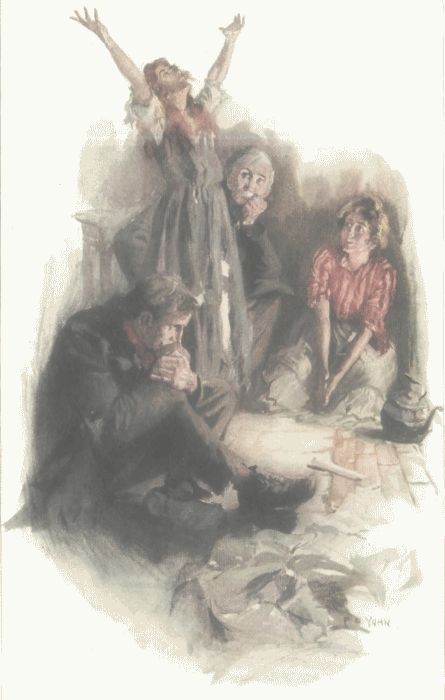
"I'm alive! I'm alive!" she cried out.
"I'm alive! I'm alive!" she cried out, "I've got ter be took care ofnow! That's why I like wot she tells about it. So does the women. Weain't no more reason ter be sure of wot the curick says than ter be sureo' this. Dunno as I 've got ter choose either way, but if I 'ad, I'dchoose the cheerflest."
Dart had sat staring at her—so had Polly—so had the thief. Dart rubbedhis forehead.
"I do not understand," he said.
"'T ain't understanding! It's believin'. Bless yer, shedoesn'tunderstand. I say, let's go an' talk to 'er a bit. She don't mind nothin',an' she'll let us in. We can leave Polly an' 'im 'ere. They can make somemore tea an' drink it."
It ended in their going out of the room together again and stumbling oncemore down the stairway's crookedness. At the bottom of the first shortflight they stopped in the darkness and Glad knocked at a door with asummons manifestly expectant of cheerful welcome. She used the formula shehad used before.
"'S on'y me, Miss Montaubyn," she cried out. "'S on'y Glad."
The door opened in wide welcome, and confronting them as she held itshandle stood a small old woman with an astonishing face. It wasastonishing because while it was withered and wrinkled with marks of pastyears which had once stamped their reckless unsavoriness upon its everyline, some strange redeeming thing had happened to it and its expressionwas that of a creature to whom the opening of a door could only mean theentrance—the tumbling in as it were—of hopes realized. Its surface wasswept clean of even the vaguest anticipation of anything not to bedesired. Smiling as it did through the black doorway into the unrelievedshadow of the passage, it struck Antony Dart at once that it actuallyimplied this—and that in this place—and indeed in any place—nothingcould have been more astonishing. What could, indeed?
"Well, well," she said, "come in, Glad, bless yer."
"I've brought a gent to 'ear yer talk a bit," Glad explained informally.
The small old woman raised her twinkling old face to look at him.
"Ah!" she said, as if summing up what was before her. "'Ethinks it'sworse than it is, doesn't 'e, now? Come in, sir, do."
This time it struck Dart that her look seemed actually to anticipate theevolving of some wonderful and desirable thing from himself. As if evenhis gloom carried with it treasure as yet undisplayed. As she knew nothingof the ten sovereigns, he wondered what, in God's name, she saw.
The poverty of the little square room had an odd cheer in it. Muchscrubbing had removed from it the objections manifest in Glad's roomabove. There was a small red fire in the grate, a strip of old, but gaycarpet before it, two chairs and a table were covered with a harlequinpatchwork made of bright odds and ends of all sizes and shapes. The fogin all its murky volume could not quite obscure the brightness of theoften rubbed window and its harlequin curtain drawn across upon a string.
"Bless yer," said Miss Montaubyn, "sit down."
Dart sat and thanked her. Glad dropped upon the floor and girdled herknees comfortably while Miss Montaubyn took the second chair, which wasclose to the table, and snuffed the candle which stood near a basket ofcolored scraps such as, without doubt, had made the harlequin curtain.
"Yer won't mind me goin' on with me bit o' work?" she chirped.
"Tell 'im wot it is," Glad suggested.
"They come from a dressmaker as is in a small way," designating the scrapsby a gesture. "I clean up for 'er an' she lets me 'ave 'em. I make 'em upinto anythink I can—pin-cushions an' bags an' curtings an' balls.Nobody'd think wot they run to sometimes. Now an' then I sell some of 'em.Wot I can't sell I give away."
"Drunken Bet's biby plays with 'er ball all day," said Glad.
"Ah!" said Miss Montaubyn, drawing out a long needleful of thread, "Bet,shethinks it worse than it is."
"Could it be worse?" asked Dart. "Could anything be worse than everythingis?"
"Lots," suggested Glad; "might 'ave broke your back, might 'ave a fever,might be in jail for knifin' someone. 'E wants to 'ear you talk, MissMontaubyn; tell 'im all about yerself."
"Me!" her expectant eyes on him. "'E wouldn't want to 'ear it. I shouldn'twant to 'ear it myself. Bein' on the 'alls when yer a pretty girl ain't an'elpful life; an' bein' took up an' dropped down till yer dropped in thegutter an' don't know 'ow to get out—it's wot yer mustn't let yer mind goback to."
"That's wot the lidy said," called out Glad. "Tell 'im about the lidy. Shedoesn't even know who she was." The remark was tossed to Dart.
"Never even 'eard 'er name," with unabated cheer said Miss Montaubyn."She come an' she went an' me too low to do anything but lie an' look at'er and listen. An' 'Which of us two is mad?' I ses to myself. But I laythinkin' and thinkin'—an' it was so cheerfle I couldn't get it out of me'ead—nor never 'ave since."
"What did she say?"
"I couldn't remember the words—it was the way they took away things abody's afraid of. It was about things never 'avin' really been like wot wethought they was. Godamighty now, there ain't a bit of 'arm in 'im."
"What?" he said with a start.
"'E never done the accidents and the trouble. It was us as went out of thelight into the dark. If we'd kep' in the light all the time, an' thoughtabout it, an' talked about it, we'd never 'ad nothin' else. 'T ain'tpunishment neither. 'T ain't nothin' but the dark—an' the dark ain'tnothin' but the light bein' away. 'Keep in the light,' she ses, 'neverthink of nothin' else, an' then you'll begin an' see things. Everybody'sbeen afraid. There ain't no need. You believe that.'"
"Believe?" said Dart heavily.
She nodded.
"'Yes,' ses I to 'er, 'that's where the trouble comes in—believin'.' Andshe answers as cool as could be: 'Yes, it is,' she ses, 'we've all beenthinkin' we've been believin', an' none of us 'as. If we 'ad what'd therebe to be afraid of? If we believed a king was givin' us our livin' an'takin' care of us who'd be afraid of not 'avin' enough to eat?'"
"Who?" groaned Dart. He sat hanging his head and staring at the floor.This was another phase of the dream.
"'Where is 'E?' I ses. ''Im as breaks old women's legs an' crushes babiesunder wheels—so as they'll be resigned?' An' all of a sudden she callsout quite loud: 'Nowhere,' she ses. 'An' never was. But 'Im as stretchedforth the 'eavens an' laid the foundations of the earth, 'Im as is theLife an' Love of the world, 'E's 'ere! Stretch out yer 'and,' she ses,'an' call out, "Speak, Lord, thy servant 'eareth," an' ye'll 'ear an'see. An' never you stop sayin' it—let yer 'eart beat it an' yerbreath breathe it—an' yer'll find yer goin' about laughin' soft toyerself an' lovin' every-thin' as if it was yer own child at breast. An'no'arm can come to yer. Try it when yer go 'ome.'"
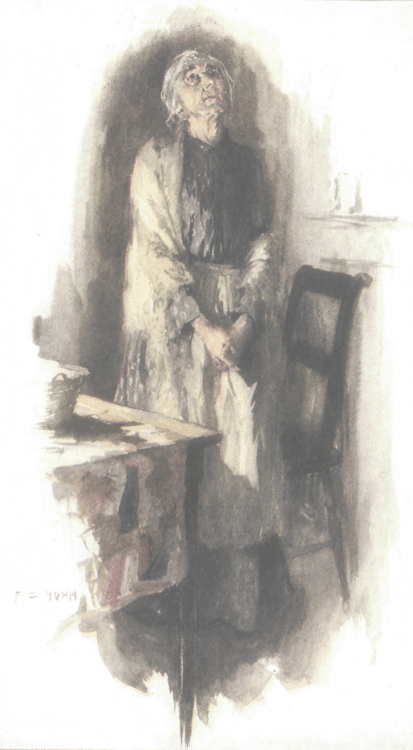
"Speak, Lord, thy servant 'eareth."
"Did you?" asked Dart.
Glad answered for her with a tremulous—yes it was a tremulous—giggle,a weirdly moved little sound.
"When she wakes in the mornin' she ses to 'erself, 'Good things is goin'to come to-day—cheerfle things,' When there's a knock at the door sheses, 'Somethin' friendly's comin' in.' An' when Drunken Bet's makin' a rowan' ragin' an' tearin' an' threatenin' to 'ave 'er eyes out of 'er fice,she ses, 'Lor, Bet, yer don't mean a word of it—yer a friend to everywoman in the 'ouse.' When she don't know which way to turn, she standsstill an' ses, 'Speak, Lord, thy servant 'eareth,' an' then she doeswotever next comes into 'er mind—an' she says it's allus the rightanswer. Sometimes," sheepishly, "I've tried it myself—p'raps it's true. Idid it this mornin' when I sat down an' pulled me sack over me 'ead on thebridge. Polly'd been cryin' so loud all night I'd got a bit low in mestummick an'—" She stopped suddenly and turned on Dart as if light hadflashed across her mind. "Dunno nothin' about it," she stammered, "but Isaidit—just like she does—an' youcome!"
Plainly she had uttered whatever words she had used in the form of a sortof incantation, and here was the result in the living body of this mansitting before her. She stared hard at him, repeating her words: "Youcome. Yes, you did."
"It was the answer," said Miss Montaubyn, with entire simplicity as shebit off her thread, "that's wot it was."
Antony Dart lifted his heavy head.
"You believe it," he said.
"I'm livin' on believin' it," she said confidingly. "I ain't got nothin'else. An' answers keeps comin' and comin'."
"What answers?"
"Bits o' work—an' things as 'elps. Glad there, she's one."
"Aw," said Glad, "I ain't nothin'. I likes to 'ear yer tell about it. Sheses," to Dart again, a little slowly, as she watched his face withcuriously questioning eyes—"she ses 'E's in the room—same as 'E'severywhere—in this 'ere room. Sometimes she talks out loud to 'Im."
"What!" cried Dart, startled again.
The strange Majestic Awful Idea—the Deity of the Ages—to be spoken of asa mere unfeared Reality! And even as the vaguely formed thought sprang inhis brain he started once more, suddenly confronted by the meaning hissense of shock implied. What had all the sermons of all the centuries beenpreaching but that it was Reality? What had all the infidels of every agecontended but that it was Unreal, and the folly of a dream? He had neverthought of himself as an infidel; perhaps it would have shocked him to becalled one, though he was not quite sure. But that a little superannuateddancer at music-halls, battered and worn by an unlawful life, should sitand smile in absolute faith at such a—a superstition as this, stirredsomething like awe in him.
For she was smiling in entire acquiescence.
"It's what the curick ses," she enlarged radiantly. "Though 'e don'tbelieve it, pore young man; 'e on'y thinks 'e does. 'It's for 'igh an'low,' 'e ses, 'for you an' me as well as for them as is royal fambleys.The Almighty 'E's everywhere!' 'Yes,' ses I, 'I've felt 'Im 'ere—asnear as y' are yerself, sir, I 'ave—an' I've spoke to 'Im.'"
"What did the curate say?" Dart asked, amazed.
"Seemed like it frightened 'im a bit. 'We mustn't be too bold, MissMontaubyn, my dear,' 'e ses, for 'e's a kind young man as ever lived, an'often ses 'my dear' to them 'e's comfortin'. But yer see the lidy 'ad gaveme a Bible o' me own an' I'd set 'ere an' read it, an' read it an' learnedverses to say to meself when I was in bed—an' I'd got ter feel like itwas someone talkin' to me an' makin' me understand. So I ses, ''T ain'tboldness we're warned against; it's not lovin' an' trustin' enough, an'not askin' an' believin' true. Don't yer remember wot it ses: "I, evenI, am 'e that comforteth yer. Who art thou that thou art afraid of manthat shall die an' the son of man that shall be made as grass, an'forgetteth Jehovah thy Creator, that stretched forth the 'eavens an' laidthe foundations of the earth?" an' "I've covered thee with the shadder ofme 'and," it ses; an' "I will go before thee an' make the rough placessmooth;" an' "'Itherto ye 'ave asked nothin' in my name; ask thereforethat ye may receive, an' yer joy may be made full."' An' 'e looked down onthe floor as if 'e was doin' some 'ard thinkin', pore young man, an' 'eses, quite sudden an' shaky, 'Lord, I believe, 'elp thou my unbelief,' an''e ses it as if 'e was in trouble an' didn't know 'e'd spoke out loud."
"Where—how did you come upon your verses?" said Dart. "How did you findthem?"
"Ah," triumphantly, "they was all answers—they was the first answers Iever 'ad. When I first come 'ome an' it seemed as if I was goin' to beswep' away in the dirt o' the street—one day when I was near drove wildwith cold an' 'unger, I set down on the floor an' I dragged the Bible tome an' I ses: 'There ain't nothin' on earth or in 'ell as'll 'elp me. I'mgoin' to do wot the lidy said—mad or not.' An' I 'eld the book—an' I'eld my breath, too, 'cos it was like waitin' for the end o' theworld—an' after a bit I 'ears myself call out in a 'oller whisper,'Speak, Lord, thy servant 'eareth. Show me a 'ope.' An' I was tremblin'all over when I opened the book. An' there it was! 'I will go before theean' make the rough places smooth, I will break in pieces the doors ofbrass and will cut in sunder the bars of iron.' An' I knowed it was aanswer."
"You—knew—it—was an answer?"
"Wot else was it?" with a shining face. "I'd arst for it, an' there itwas. An' in about a hour Glad come runnin' up 'ere, an' she'd 'ad a bit o'luck—"
"'Twasn't nothin' much," Glad broke in deprecatingly, "on'y I'd gotsomethin' to eat an' a bit o' fire."
"An' she made me go an' 'ave a 'earty meal, an' set an' warm meself. An'she was that cheerfle an' full o' pluck, she 'elped me to forget about thethings that was makin' me into a madwoman. Shewas the answer—same asthe book 'ad promised. They comes in different wyes the answers does.Bless yer, they don't come in claps of thunder an' streaks o'lightenin'—they just comes easy an' natural—so's sometimes yer don'tthink for a minit or two that they're answers at all. But it comes to yerin a bit an' yer 'eart stands still for joy. An' ever since then I just goto me book an' arst. P'raps," her smile an illuminating thing, "me bein'the low an' pore in spirit at the beginnin', an' settin' 'ere all alone bymeself day in an' day out, just thinkin' it all over—an' arstin'—an'waitin'—p'raps light was gave me 'cos I was in such a little place an' inthe dark. But I ain't pore in spirit now. Lor', no, yer can't be whenyer've on'y got to believe. 'An' 'itherto ye 'ave arst nothin' in my name;arst therefore that ye may receive an' yer joy be made full.'"
"Am I sitting here listening to an old female reprobate's disquisition onreligion?" passed through Antony Dart's mind. "Why am I listening? I amdoing it because here is a creature who believes—knowing no doctrine,knowing no church. She believes—she thinks she knowsher Deity is byher side. She is not afraid. To her simpleness the awful Unknown is theKnown—and withher."
"Suppose it were true," he uttered aloud, in response to a sense of inwardtremor, "suppose—it—were—true?" And he was not speaking either to thewoman or the girl, and his forehead was damp.
"Gawd!" said Glad, her chin almost on her knees, her eyes staringfearsomely. "S'pose it was—an' us sittin' 'ere an' not knowin' it—an' noone knowin' it—nor gettin' the good of it. Sime as if—" pondering hardin search of simile, "sime as if no one 'ad never knowed about'lectricity, an' there wasn't no 'lectric lights nor no 'lectric nothin'.Onct nobody knowed, an' all the sime it was there—jest waitin'."
Her fantastic laugh ended for her with a little choking, vaguely hystericsound.
"Blimme," she said. "Ain't it queer, us not knowin'—if it's true."
Antony Dart bent forward in his chair. He looked far into the eyes of theex-dancer as if some unseen thing within them might answer him. MissMontaubyn herself for the moment he did not see.
"What," he stammered hoarsely, his voice broken with awe, "what of thehideous wrongs—the woes and horrors—and hideous wrongs?"
"There wouldn't be none if wewas right—if we never thought nothin' but'Good's comin'—good's 'ere.' If we everyone of us thought it—every minitof every day."
She did not know she was speaking of a millennium—the end of the world.She sat by her one candle, threading her needle and believing she wasspeaking of To-day.
He laughed a hollow laugh.
"If wewere right!" he said. "It would take long—long—long—to make usall so."
"It would be slow p'raps. Well, so it would—but good comes quick for themas begins callin' it. It's been quick for me," drawing her threadthrough the needle's eye triumphantly. "Lor', yes, me legs is better—meluck's better—people's better. Bless yer, yes!"
"It's true," said Glad; "she gets on somehow. Things comes. She neverwants no drink. Me now," she applied to Miss Montaubyn, "if I took it upsame as you—wot'd come to a gal like me?"
"Wot ud yer want ter come?" Dart saw that in her mind was an absolute lackof any premonition of obstacle. "Wot'd yer arst fer in yer own mind?"
Glad reflected profoundly.
"Polly," she said, "she wants to go 'ome to 'er mother an' to the country.I ain't got no mother an' wot I 'ear of the country seems like I'd gettired of it. Nothin' but quiet an' lambs an' birds an' things growin.' Me,I likes things goin' on. I likes people an' 'and organs an' 'buses. I'dstay 'ere—same as I told you," with a jerk of her hand toward Dart.
"An' do things in the court—if I 'ad a bit o' money. I don't want tolive no gay life when I'm a woman. It's too 'ard. Us pore uns ends toobad. Wisht I knowed I could get on some'ow."
"Good'll come," said Miss Montaubyn. "Just you say the same as me everymornin'—'Good's fillin' the world, an' some of it's comin' to me. It'sbein' sent—an' I'm goin' to meet it. It's comin'—it's comin'.'" She bentforward and touched the girl's shoulder with her astonishing eyes alight."Bless yer, wot's in my room's in yours; Lor', yes."
Glad's eyes stared into hers, they became mysteriously, almost awesomely,astonishing also.
"Is it?" she breathed in a hushed voice.
"Yes, Lor', yes! When yer get up in the mornin' you just stand still an'arstit. 'Speak, Lord,' ses you; 'speak, Lord—'"
"Thy servant 'eareth," ended Glad's hushed speech. "Blimme, but I'm goin'to try it!"
Perhaps the brain of her saw it still as an incantation, perhaps the soulof her, called up strangely out of the dark and still new-born and blindand vague, saw it vaguely and half blindly as something else.
Dart was wondering which of these things were true.
"We've never been expectin' nothin' that's good," said Miss Montaubyn."We're allus expectin' the other. Who isn't? I was allus expectin'rheumatiz an' 'unger an' cold an' starvin' old age. Wot was you lookin'for?" to Dart.
He looked down on the floor and answered heavily.
"Failing brain—failing life—despair—death!"
"None of 'em's comin'—if yer don't call 'em. Stand still an' listen forthe other. It's the other that's true."
She was without doubt amazing. She chirped like a bird singing on a bough,rejoicing in token of the shining of the sun.
"It's wot yer can work on—this," said Glad. "The curick—'e's a good sortan' no' 'arm in 'im—but 'e ses: 'Trouble an' 'unger is ter teach yer tersubmit. Accidents an' coughs as tears yer lungs is sent you to prepareyer for 'eaven. If yer loves 'Im as sends 'em, yer'll go there.' ''Ave yerever bin?' ses I. ''Ave yer ever saw anyone that's bin? 'Ave yer ever sawanyone that's saw anyone that's bin?' 'No,' 'e ses. 'Don't, me girl,don't!' 'Garn,' I ses; 'tell me somethin' as'll do me some good afore I'mdead! 'Eaven's too far off.'"
"The kingdom of 'eaven is at 'and," said Miss Montaubyn. "Bless yer, yes,just 'ere."
Antony Dart glanced round the room. It was a strange place. But somethingwashere. Magic, was it? Frenzy—dreams—what?
He heard from below a sudden murmur and crying out in the street. MissMontaubyn heard it and stopped in her sewing, holding her needle andthread extended.
Glad heard it and sprang to her feet.
"Somethin's 'appened," she cried out. "Someone's 'urt."
She was out of the room in a breath's space. She stood outside listening afew seconds and darted back to the open door, speaking through it. Theycould hear below commotion, exclamations, the wail of a child.
"Somethin's 'appened to Bet!" she cried out again. "I can 'ear the child."
She was gone and flying down the staircase; Antony Dart and Miss Montaubynrose together. The tumult was increasing; people were running about inthe court, and it was plain a crowd was forming by the magic which callsup crowds as from nowhere about the door. The child's screams rose shrillabove the noise. It was no small thing which had occurred.
"I must go," said Miss Montaubyn, limping away from her table. "P'raps Ican 'elp. P'raps you can 'elp, too," as he followed her.
They were met by Glad at the threshold. She had shot back to them,panting.
"She was blind drunk," she said, "an' she went out to get more. She triedto cross the street an' fell under a car She'll be dead in five minits.I'm goin' for the biby."
Dart saw Miss Montaubyn step back into her room. He turned involuntarilyto look at her.
She stood still a second—so still that it seemed as if she was notdrawing mortal breath. Her astonishing, expectant eyes closed themselves,and yet in closing spoke expectancy still.
"Speak, Lord," she said softly, but as if she spoke to Something whosenearness to her was such that her hand might have touched it. "Speak,Lord, thy servant 'eareth."
Antony Dart almost felt his hair rise. He quaked as she came near, herpoor clothes brushing against him. He drew back to let her pass first, andfollowed her leading.
The court was filled with men, women, and children, who surged about thedoorway, talking, crying, and protesting against each other's crowding.Dart caught a glimpse of a policeman fighting his way through with adoctor. A dishevelled woman with a child at her dirty, bare breast had gotin and was talking loudly.
"Just outside the court it was," she proclaimed, "an' I saw it. If she'dbin 'erself it couldn't 'ave 'appened. 'No time for 'osspitles,' ses I.She's not twenty breaths to dror; let 'er die in 'er own bed, pore thing!"And both she and her baby breaking into wails at one and the same time,other women, some hysteric, some maudlin with gin, joined them in aterrified outburst.
"Get out, you women," commanded the doctor, who had forced his way acrossthe threshold. "Send them away, officer," to the policeman.
There were others to turn out of the room itself, which was crowded withmorbid or terrified creatures, all making for confusion. Glad had seizedthe child and was forcing her way out into such air as there was outside.
The bed—a strange and loathly thing—stood by the empty, rusty fireplace.Drunken Bet lay on it, a bundle of clothing over which the doctor bent forbut a few minutes before he turned away.
Antony Dart, standing near the door, heard Miss Montaubyn speak to him ina whisper.
"May I go to 'er?" and the doctor nodded.
She limped lightly forward and her small face was white, but expectantstill. What could she expect now—O Lord, what?
An extraordinary thing happened. An abnormal silence fell. The owners ofsuch faces as on stretched necks caught sight of her seemed in a flash tocommunicate with others in the crowd.
"Jinny Montaubyn!" someone whispered. And "Jinny Montaubyn" was passedalong, leaving an awed stirring in its wake. Those whom the pressureoutside had crushed against the wall near the window in a passionatehurry, breathed on and rubbed the panes that they might lay their facesto them. One tore out the rags stuffed in a broken place and listenedbreathlessly.
Jinny Montaubyn was kneeling down and laying her small old hand on themuddied forehead. She held it there a second or so and spoke in a voicewhose low clearness brought back at once to Dart the voice in which shehad spoken to the Something upstairs.
"Bet," she said, "Bet." And then more soft still and yet more clear, "Bet,my dear."
It seemed incredible, but it was a fact. Slowly the lids of the woman'seyes lifted and the pupils fixed themselves on Jinny Montaubyn, who leanedstill closer and spoke again.
"'T ain't true," she said. "Not this. 'T ain't true. There is nodeath," slow and soft, but passionately distinct."There—is—no—death."
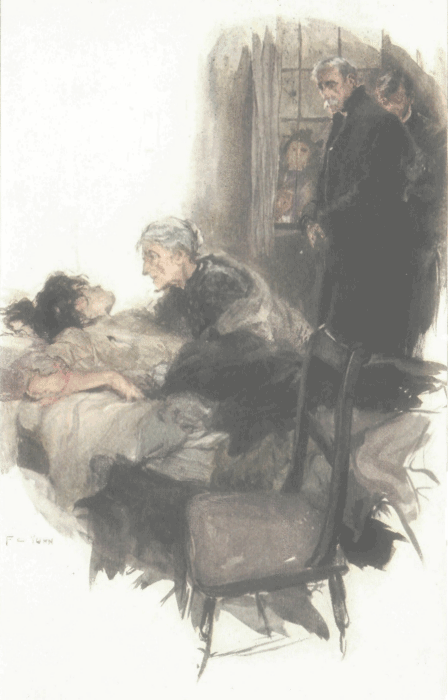
"There—is—no—death."
The muscles of the woman's face twisted it into a rueful smile. The threewords she dragged out were so faint that perhaps none but Dart's strainedears heard them.
"Wot—price—me?"
The soul of her was loosening fast and straining away, but Jinny Montaubynfollowed it.
"There—is—no—death,"and her low voice had the tone of a slendersilver trumpet. "In a minit yer'll know—in a minit. Lord," lifting herexpectant face, "show her the wye."
Mysteriously the clouds were clearing from the sodden face—mysteriously.Miss Montaubyn watched them as they were swept away! A minute—twominutes—and they were gone. Then she rose noiselessly and stood lookingdown, speaking quite simply as if to herself.
"Ah," she breathed, "she doesknow now—fer sure an' certain."
Then Antony Dart, turning slightly, realized that a man who had enteredthe house and been standing near him, breathing with light quickness,since the moment Miss Montaubyn had knelt, was plainly the person Glad hadcalled the "curick," and that he had bowed his head and covered his eyeswith a hand which trembled.
IV
He was a young man with an eager soul, and his work in Apple Blossom Courtand places like it had torn him many ways. Religious conventionsestablished through centuries of custom had not prepared him for lifeamong the submerged. He had struggled and been appalled, he had wrestledin prayer and felt himself unanswered, and in repentance of the feelinghad scourged himself with thorns. Miss Montaubyn, returning from thehospital, had filled him at first with horror and protest.
"But who knows—who knows?" he said to Dart, as they stood and talkedtogether afterward, "Faith as a little child. That is literally hers. AndI was shocked by it—and tried to destroy it, until I suddenly saw what Iwas doing. I was—in my cloddish egotism—trying to show her that she wasirreverent becauseshe could believe what in my soul I do not, though Idare not admit so much even to myself. She took from some strange passingvisitor to her tortured bedside what was to her a revelation. She heard itfirst as a child hears a story of magic. When she came out of thehospital, she told it as if it was one. I—I—" he bit his lips andmoistened them, "argued with her and reproached her. Christ the Merciful,forgive me! She sat in her squalid little room with her magic—sometimesin the dark—sometimes without fire, and she clung to it, and loved itand asked it to help her, as a child asks its father for bread. When shewas answered—and God forgive me again for doubting that the simple goodthat came to her wasan answer—when any small help came to her, she wasa radiant thing, and without a shadow of doubt in her eyes told me of itas proof—proof that she had been heard. When things went wrong for a dayand the fire was out again and the room dark, she said, 'I 'aven't keptnear enough—I 'aven't trusted true. It will be gave me soon,' and whenonce at such a time I said to her, 'We must learn to say, Thy will bedone,' she smiled up at me like a happy baby and answered: 'Thy will bedone on earth as it is in 'eaven. Lor', there's no cold there, nor no'unger nor no cryin' nor pain. That's the way the will is done in 'eaven.That's wot I arst for all day long—for it to be done on earth as it is in'eaven.' What could I say? Could I tell her that the will of the Deity onthe earth he created was only the will to do evil—to give pain—to crushthe creature made in His own image. What else do we mean when we say underall horror and agony that befalls, 'It is God's will—God's will be done.'Base unbeliever though I am, I could not speak the words. Oh, she hassomething we have not. Her poor, little misspent life has changed itselfinto a shining thing, though it shines and glows only in this hideousplace. She herself does not know of its shining. But Drunken Bet wouldstagger up to her room and ask to be told what she called her 'pantermine'stories. I have seen her there sitting listening—listening with strangequiet on her and dull yearning in her sodden eyes. So would other andworse women go to her, and I, who had struggled with them, could see thatshe had reached some remote longing in their beings which I had nevertouched. In time the seed would have stirred to life—it is beginning tostir even now. During the months since she came back to the court—thoughthey have laughed at her—both men and women have begun to see her as acreature weirdly set apart. Most of them feel something like awe of her;they half believe her prayers to be bewitchments, but they want them ontheir side. They have never wanted mine. That I have known—known. Shebelieves that her Deity is in Apple Blossom Court—in the dire holes itspeople live in, on the broken stairway, in every nook and awful cranny ofit—great Glory we will not see—only waiting to be called and to answer.Do Ibelieve it—do you—do any of those anointed of us who preach eachday so glibly 'God is everywhere'? Who is the one who believes? If therewere such a man he would go about as Moses did when 'He wist not that hisface shone.'"
They had gone out together and were standing in the fog in the court. Thecurate removed his hat and passed his handkerchief over his damp forehead,his breath coming and going almost sobbingly, his eyes staring straightbefore him into the yellowness of the haze.
"Who," he said after a moment of singular silence, "who are you?"
Antony Dart hesitated a few seconds, and at the end of his pause he puthis hand into his overcoat pocket.
"If you will come upstairs with me to the room where the girl Glad lives,I will tell you," he said, "but before we go I want to hand something overto you."
The curate turned an amazed gaze upon him.
"What is it?" he asked.
Dart withdrew his hand from his pocket, and the pistol was in it.
"I came out this morning to buy this," he said. "I intended—never mindwhat I intended. A wrong turn taken in the fog brought me here. Take thisthing from me and keep it."
The curate took the pistol and put it into his own pocket without comment.In the course of his labors he had seen desperate men and desperate thingsmany times. He had even been—at moments—a desperate man thinkingdesperate things himself, though no human being had ever suspected thefact. This man had faced some tragedy, he could see. Had he been on theverge of a crime—had he looked murder in the eyes? What had made himpause? Was it possible that the dream of Jinny Montaubyn being in the airhad reached his brain—his being?
He looked almost appealingly at him, but he only said aloud:
"Let us go upstairs, then."
So they went.
As they passed the door of the room where the dead woman lay Dart went inand spoke to Miss Montaubyn, who was still there.
"If there are things wanted here," he said, "this will buy them." And heput some money into her hand.
She did not seem surprised at the incongruity of his shabbiness producingmoney.
"Well, now," she said, "I waswonderin' an' askin'. I'd like 'er cleanan' nice, an' there's milk wanted bad for the biby."
In the room they mounted to Glad was trying to feed the child with breadsoftened in tea. Polly sat near her looking on with restless, eager eyes.She had never seen anything of her own baby but its limp new-born and deadbody being carried away out of sight. She had not even dared to ask whatwas done with such poor little carrion. The tyranny of the law of lifemade her want to paw and touch this lately born thing, as her agony hadgiven her no fruit of her own body to touch and paw and nuzzle and caressas mother creatures will whether they be women or tigresses or doves orfemale cats.
"Let me hold her, Glad," she half whimpered. "When she's fed let me gether to sleep."
"All right," Glad answered; "we could look after 'er between us wellenough."
The thief was still sitting on the hearth, but being full fed andcomfortable for the first time in many a day, he had rested his headagainst the wall and fallen into profound sleep.
"Wot's up?" said Glad when the two men came in. "Is anythin' 'appenin'?"
"I have come up here to tell you something," Dart answered. "Let us sitdown again round the fire. It will take a little time."
Glad with eager eyes on him handed the child to Polly and sat downwithout a moment's hesitance, avid of what was to come. She nudged thethief with friendly elbow and he started up awake.
"'E's got somethin' to tell us," she explained. "The curick's come up to'ear it, too. Sit 'ere, Polly," with elbow jerk toward the bundle ofsacks. "It's got its stummick full an' it'll go to sleep fast enough."
So they sat again in the weird circle. Neither the strangeness of thegroup nor the squalor of the hearth were of a nature to be new things tothe curate. His eyes fixed themselves on Dart's face, as did the eyes ofthe thief, the beggar, and the young thing of the street. No one glancedaway from him.
His telling of his story was almost monotonous in its semi-reflectivequietness of tone. The strangeness to himself—though it was a strangenesshe accepted absolutely without protest—lay in his telling it at all, andin a sense of his knowledge that each of these creatures would understandand mysteriously know what depths he had touched this day.
"Just before I left my lodgings this morning," he said, "I found myselfstanding in the middle of my room and speaking to Something aloud. I didnot know I was going to speak. I did not know what I was speaking to. Iheard my own voice cry out in agony, 'Lord, Lord, what shall I do to besaved?'"
The curate made a sudden movement in his place and his sallow young faceflushed. But he said nothing.
Glad's small and sharp countenance became curious.
"'Speak, Lord, thy servant 'eareth,'" she quoted tentatively.
"No," answered Dart; "it was not like that. I had never thought of suchthings. I believed nothing. I was going out to buy a pistol and when Ireturned intended to blow my brains out."
"Why?" asked Glad, with passionately intent eyes; "why?"
"Because I was worn out and done for, and all the world seemed worn outand done for. And among other things I believed I was beginning slowly togo mad."
From the thief there burst forth a low groan and he turned his face tothe wall.
"I've been there," he said; "I'm near there now."
Dart took up speech again.
"There was no answer—none. As I stood waiting—God knows for what—thedead stillness of the room was like the dead stillness of the grave. And Iwent out saying to my soul, 'This is what happens to the fool who criesaloud in his pain.'"
"I've cried aloud," said the thief, "and sometimes it seemed as if ananswer was coming—but I always knew it never would!" in a tortured voice.
"'T ain't fair to arst that wye," Glad put in with shrewd logic. "MissMontaubyn she allers knows it willcome—an' it does."
"Something—not myself—turned my feet toward this place," said Dart. "Iwas thrust from one thing to another. I was forced to see and hear thingsclose at hand. It has been as if I was under a spell. The woman in theroom below—the woman lying dead!" He stopped a second, and then went on:"There is too much that is crying out aloud. A man such as I am—it hasforceditself upon me—cannot leave such things and give himself to thedust. I cannot explain clearly because I am not thinking as I amaccustomed to think. A change has come upon me. I shall not use thepistol—as I meant to use it."
Glad made a friendly clutch at the sleeve of his shabby coat.
"Right O!" she cried. "That's it! You buck up sime as I told yer. Y' ain'tstony broke an' there's allers to-morrer."
Antony Dart's expression was weirdly retrospective.
"I did not think so this morning," he answered.
"But there is," said the girl. "Ain't there now, curick? There's a lot o'work in yer yet; yer could do all sorts o' things if y' ain't too proud.I'll 'elp yer. So'll the curick. Y' ain't found out yet what a littlefolks can live on till luck turns. Me, I'm goin' to try Miss Montaubyn'swye. Le's both try. Le's believe things is comin'. Le's get 'er to talkto us some more."
The curate was thinking the thing over deeply.
"Yer see," Glad enlarged cheerfully, "yer look almost like a gentleman.P'raps yer can write a good 'and an' spell all right. Can yer?"
"Yes."
"I think, perhaps," the curate began reflectively, "particularly if youcan write well, I might be able to get you some work."
"I do not want work," Dart answered slowly. "At least I do not want thekind you would be likely to offer me."
The curate felt a shock, as if cold water had been dashed over him.Somehow it had not once occurred to him that the man could be one of theeducated degenerate vicious for whom no power to help lay in anyhands—yet he was not the common vagrant—and he was plainly on the pointof producing an excuse for refusing work.
The other man, seeing his start and his amazed, troubled flush, put out ahand and touched his arm apologetically.
"I beg your pardon," he said. "One of the things I was going to tellyou—I had not finished—was that I amwhat is called a gentleman. I amalso what the world knows as a rich man. I am Sir Oliver Holt."
Each member of the party gazed at him aghast. It was an enormous name toclaim. Even the two female creatures knew what it stood for. It was thename which represented the greatest wealth and power in the world offinance and schemes of business. It stood for financial influence whichcould change the face of national fortunes and bring about crises. It wasknown throughout the world. Yesterday the newspaper rumor that its ownerhad mysteriously left England had caused men on 'Change to discusspossibilities together with lowered voices.
Glad stared at the curate. For the first time she looked disturbed andalarmed.
"Blimme," she ejaculated, "'e's gone off 'is nut, pore chap!—'e's goneoff it!"
"No," the man answered, "you shall come to me"—he hesitated a secondwhile a shade passed over his eyes—"to-morrow. And you shall see."
He rose quietly to his feet and the curate rose also. Abnormal as theclimax was, it was to be seen that there was no mistake about therevelation. The man was a creature of authority and used to carryingconviction by his unsupported word. That made itself, by some clear,unspoken method, plain.
"You are Sir Oliver Holt! And a few hours ago you were on the point of—"
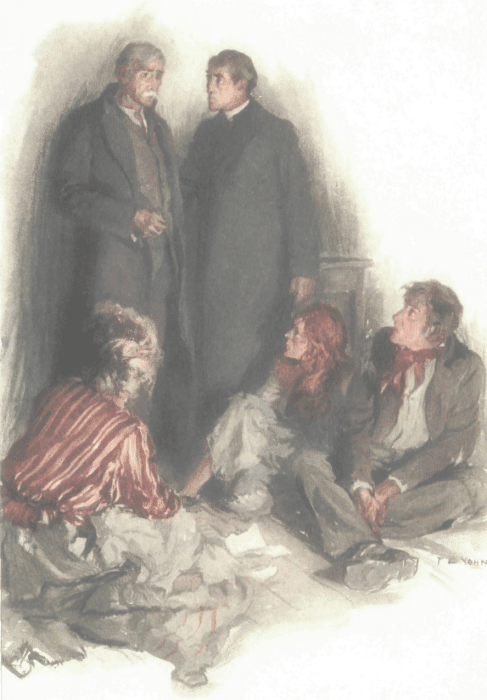
"And a few hours ago you were on the point of—"
"Ending it all—in an obscure lodging. Afterward the earth would have beenshovelled on to a work-house coffin. It was an awful thing." He shook offa passionate shudder. "There was no wealth on earth that could give me amoment's ease—sleep—hope—life. The whole world was full of things Iloathed the sight and thought of. The doctors said my condition wasphysical. Perhaps it was—perhaps to-day has strangely given a healthfuljolt to my nerves—perhaps I have been dragged away from the agony ofmorbidity and plunged into new intense emotions which have saved me fromthe last thing and the worst—savedme!"
He stopped suddenly and his face flushed, and then quite slowly turnedpale.
"Saved me!" he repeated the words as the curate saw the awed bloodcreepingly recede. "Who knows, who knows! How many explanations one isready to give before one thinks of what we say we believe. Perhaps itwas—the Answer!"
The curate bowed his head reverently.
"Perhaps it was."
The girl Glad sat clinging to her knees, her eyes wide and awed and with asudden gush of hysteric tears rushing down her cheeks.
"That's the wye! That's the wye!" she gulped out. "No one won't neverbelieve—they won't, never. That's what she sees, Miss Montaubyn. Youdon't, 'edon't," with a jerk toward the curate. "I ain't nothin' butme, but blimme if I don't—blimme!"
Sir Oliver Holt grew paler still. He felt as he had done when JinnyMontaubyn's poor dress swept against him. His voice shook when he spoke.
"So do I," he said with a sudden deep catch of the breath; "it was theAnswer."
In a few moments more he went to the girl Polly and laid a hand on hershoulder.
"I shall take you home to your mother," he said. "I shall take you myselfand care for you both. She shall know nothing you are afraid of herhearing. I shall ask her to bring up the child. You will help her."
Then he touched the thief, who got up white and shaking and with eyesmoist with excitement.
"You shall never see another man claim your thought because you have nottime or money to work it out. You will go with me. There are to-morrowsenough for you!"
Glad still sat clinging to her knees and with tears running, but theugliness of her sharp, small face was a thing an angel might have pausedto see.
"You don't want to go away from here," Sir Oliver said to her, and sheshook her head.
"No, not me. I told yer wot I wanted. Lemme do it."
"You shall," he answered, "and I will help you."
The things which developed in Apple Blossom Court later, the things whichcame to each of those who had sat in the weird circle round the fire, therevelations of new existence which came to herself, aroused no amazementin Jinny Montaubyn's mind. She had asked and believed all things—and allthis was but another of the Answers.
- Recently updated
-
-
2026-07-29 23:42:56A Man of Business, by Honore de Balzac
-
2026-07-29 23:42:56Master Humphrey's Clock, by Charles Dickens
-
2026-07-29 23:42:56The Project Gutenberg eBook of La Duchesse De Palliano, by Stendhal
-
2026-07-29 23:42:56Phantasmagoria, by Lewis Carroll
-
2026-07-29 23:42:56Passing of the Third Floor Back
-
2026-07-29 23:42:56Hunted Down, by Charles Dickens
-
2026-07-29 23:42:56The Project Gutenberg eBook of Down with the Cities!, by Tadashi Nakashima
-
2026-07-29 23:42:56The Project Gutenberg eBook of The Secret Guide to Computers, by Russ Walter
-
- Hot ranking
-
-
2026-07-29 23:42:56The Passionate Pilgrim
-
2026-07-29 23:42:56Master Humphrey's Clock, by Charles Dickens
-
2026-07-29 23:42:56The Project Gutenberg eBook of The Compleat Angler, by Izaak Walton
-
2026-07-29 23:42:56The Project Gutenberg eBook of Latin Vulgate, Daniel: Prophetia Danielis, by Anonymous
-
2026-07-29 23:42:56The Project Gutenberg eBook of My Buried Treasure, by Richard Harding Davis
-
2026-07-29 23:42:56The Project Gutenberg eBook of Across the Plains, by Robert Louis Stevenson
-
2026-07-29 23:42:56The Project Gutenberg eBook of The Castle of Otranto, by Horace Walpole
-
2026-07-29 23:42:56Wieland; Or the Transformation, by Charles Brockden Brown
-
- Friendly links
-
- science kits for 3 year olds under 100 dollars educational fashion dolls for 14 year olds educational wooden montessori toys for 10 year olds sewing kits for 12 year olds under 10 dollars best beach toys for 10 year olds under 30 dollars best hand puppets for 11 year olds under 50 dollars miniature dollhouses for 11 year olds under 10 dollars best sewing kits for 13 year olds best play tunnels for road trips doll cribs for 6 year olds under 50 dollars
- The Project Gutenberg eBook of Advanced Toy Making for Schools, by David M. Mitchell
- The Project Gutenberg eBook of Making Tin Can Toys, by Edward Thatcher.
- The Project Gutenberg eBook of Toy
- The Project Gutenberg eBook of How to Make Electrical Machines, by R. A. R. Bennett
- The Project Gutenberg eBook of The Coral Island, by R. M. Ballantyne
- Prester John
- The Figure in the Carpet, by Henry James
- The Project Gutenberg eBook of Enoch Soames: A Memory of the Eighteen
- The Man Between, by Amelia E. Barr
- Of the Nature of Things